
In an era where smart devices are constantly striving for smaller size and higher performance, heat dissipation has become a crucial and unavoidable issue in the electronics industry. Whether it’s mobile phones, computers, LEDs, or new energy vehicle battery packs, stable temperature control is key to ensuring device lifespan and reliability. And playing a central role in the entire heat dissipation system is what we commonly call thermal interface material (TIM).
Today, let’s delve into the types and properties of thermal interface materials and how they help devices achieve higher heat dissipation efficiency, starting from a product perspective.
01 Why do electronic products need thermal interface materials?
In practical applications, there are often tiny gaps between the heat sink and the heat source. These gaps are filled with air, and air has extremely low thermal conductivity, significantly hindering heat transfer.
The role of thermal interface materials is to fill these gaps, allowing heat to be smoothly transferred to the heat sink, thereby improving overall heat dissipation efficiency.
In other words, thermal interface materials are the key bridge that helps devices “breathe” and dissipate heat.
02 Huayue Thermal Conductive Materials Product Overview
As a professional manufacturer of thermal interface materials, our product system covers mainstream heat dissipation application needs. Each product category has its own characteristics and is suitable for different environments and structural designs.
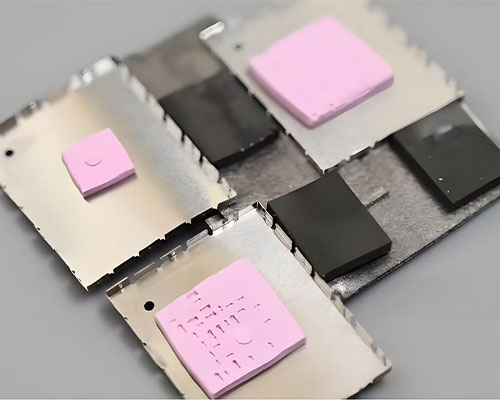
① Thermal Conductive Silicone Pads / Thermal Conductive Silicone Sheets
Features:
Wide range of thermal conductivity options (1~15W/m·K, customizable)
Soft and compressible, adaptable to different assembly tolerances
Good insulation and temperature resistance
Can be cut to any size and shape
Application Scenarios: Mobile phones, computer motherboards, adapters, power supplies, charging piles, automotive electronic control modules, etc.
It is one of the most widely used and cost-effective thermal interface materials currently available.
② Thermal Conductive Silicone Cloth / Thermal Conductive Silicone Sheets
Features:
Higher pressure and temperature resistance
Suitable for both heat dissipation and insulation requirements
Surface can be reinforced with glass fiber
Typical Applications: Power supplies, transformers, LED circuit boards, automotive charging modules, etc.
Silicone cloth is particularly suitable for industries requiring “high-voltage isolation”.
③ Thermal Gel
Features:
Ultra-high flexibility, virtually no assembly stress
Automatic dispensing, suitable for intricate structures
Can remain non-curing and non-flowing for extended periods
Applications: 5G communication equipment, automotive radar, new energy batteries, servers, smart home products, etc.
Gel is a significant trend in future complex heat dissipation structures, suitable for fields with higher reliability requirements.
④ Thermal Grease/Paste
Features:
High heat transfer efficiency
Low cost
Suitable for high heat density components such as CPUs, GPUs, and power components
Available with different viscosities for customized automatic dispensing processes
This is the most classic TIM product for computer CPU/GPU heat dissipation.
⑤ Thermal Silicone Caps/Tubing
Features:
Insulating, high-temperature resistant
Protects components, wraps inductors or capacitors
Effectively reduces vibration and thermal shock
Applications: Power modules, LEDs, battery packs, automotive electronics, etc.
03 Why are our products trustworthy? Let quality speak for itself.
Every product we manufacture relies on professional equipment and rigorous testing:
Certified by UL, SGS, and RoHS.
Our production system complies with ISO9001 / IATF16949.
Performance benchmarks international brands: Laird, Fujico, and Bergers.
From thermal conductivity testing and breakdown strength testing to reliability aging testing, every batch must meet standards before leaving the factory.
Quality isn’t just talked about; it’s proven through testing.
04 Customization Support: Making thermal conductive materials better suit your application.
For different equipment structures and heat dissipation designs, we offer:
Thickness options: 0.2mm–20mm
Customized size and shape (die-cutting)
Customized performance (thermal conductivity, hardness, flame retardancy rating)
Customized colors (blue, gray, pink, green, etc.)
Whether it’s small precision electronics or large energy storage systems, we can provide customized heat dissipation interface solutions.
Conclusion: Professional Materials for Superior Heat Dissipation
Although small, thermally conductive materials are crucial to the overall stability, lifespan, and safety of the system.
We consistently adhere to a product philosophy of high quality, high performance, and high reliability, continuously innovating to help customers achieve more efficient and stable heat dissipation solutions.
If you would like to learn more about product parameters, selection advice, or require sample testing, please feel free to contact us. We will provide you with professional technical support and heat dissipation advice.